There is no format that wins on every axis. There is a format that fits what you are actually doing. Here is the honest comparison.
The quick version
| Caffeine pouch | Coffee | Pre-workout | |
|---|---|---|---|
| Typical dose | 200mg, fixed | 80–200mg, variable | 150–350mg |
| Onset | Minutes | ~30–45 min to peak | ~30–45 min to peak |
| Hands free | Yes | No | No |
| Prep needed | None | Brew or buy | Water, shaker, mixing |
| Stomach volume | None | 8–16 oz | 10–20 oz |
| Portable mid-task | Yes | Poorly | No |
Dose control is the underrated difference
The caffeine in a cup of coffee varies enormously — bean, roast, grind, brew method, and cup size all move it. Two cups from two shops can differ by more than double. If you are trying to figure out what dose actually works for you, coffee is a noisy instrument.
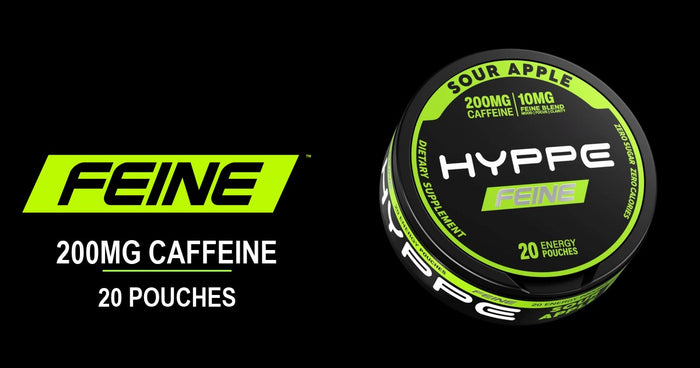
A pouch is a fixed number. FEINE is 200mg per pouch, every pouch. That makes it a measuring tool as much as a caffeine source: you learn what 200mg does for you, and then you can repeat it or halve it deliberately.
Where each one genuinely wins
Coffee wins on: the experience
Nobody drinks coffee purely for the caffeine. It is warm, it is social, it is a reason to stand up. If your morning coffee is a part of your day you enjoy, a pouch does not replace that and should not try to. Most pouch users keep their morning coffee and use pouches for the second and third windows.
Pre-workout wins on: the full stack
Pre-workout is not just caffeine. Depending on the formula you may be getting citrulline, beta-alanine, creatine, and electrolytes. If you want the whole stack for a heavy training session, a caffeine pouch is not a substitute for that formula — it is a substitute for the caffeine portion.
Where pre-workout struggles is everything outside the gym. You are not mixing a shaker bottle on a jobsite, in a truck, or before a client meeting. And the dose is often high enough that using it daily builds tolerance fast.
Pouches win on: everywhere that is not a kitchen
The advantages compound in exactly the situations where the other two fail:
- Your hands are busy. Tools, a barbell, a steering wheel, a controller. Nothing to hold or set down.
- There is nowhere to put a drink. No cupholder, no flat surface, no fridge.
- You do not want the liquid. Before a run, before a lift, before you are on camera.
- You need it now. Minutes, not the back half of an hour.
- You need it to be discreet. No can on the table, no smell, no cleanup.
Cost per serving
At the FEINE 6-can tier, a 200mg pouch runs about 22 cents. A drive-through coffee is $3 to $6. A canned energy drink is $2.50 to $3.50. A scoop of decent pre-workout typically lands between $1 and $2.
Cost is the last reason to switch, not the first — but over a year of daily use the gap is not small.
The honest recommendation
Keep the coffee you enjoy. Keep the pre-workout for the sessions that warrant the full formula. Use pouches for the windows those two cannot reach: mid-shift, mid-drive, mid-game, and the fifteen minutes before something that matters where you do not want a drink in your hand.
Most people do not pick one. They stop forcing one format to do all three jobs.
SHOP FEINE — 200MG PER POUCHTRY IT FOR YOURSELF.
200mg caffeine and L-theanine. 20 pouches per can. Zero sugar, zero nicotine.
SHOP FEINE