Most people set their caffeine cutoff by feel. The research suggests feel is exactly the wrong instrument, because the damage happens whether or not you perceive it.
The study worth knowing
Drake and colleagues (2013), published in the Journal of Clinical Sleep Medicine, gave participants 400mg of caffeine at three time points: at bedtime, 3 hours before bed, and 6 hours before bed.
All three conditions measurably disrupted sleep. The six hour condition reduced total sleep time by more than one hour as measured objectively.
The finding that should change behavior: participants in the six hour condition largely did not notice the disruption. Their subjective reports did not match what the instruments recorded. Feeling like caffeine does not affect your sleep is not evidence that it does not.
The half-life math
Caffeine's half-life averages about 5 to 6 hours in healthy adults, with a wide individual range of roughly 1.5 to 9.5 hours. Half-life means the time to clear half the dose.
Starting from a 200mg pouch taken at 3pm:
- 9pm: roughly 100mg still circulating
- 3am: roughly 50mg still circulating
Fifty milligrams at three in the morning is not nothing. It is around a cup of black tea, active while you are trying to complete deep sleep cycles.
A practical cutoff
Eight to ten hours before bed is a defensible target for a 200mg dose. Six hours is the point at which measurable disruption was still clearly present in controlled conditions, so treating six as the safe minimum rather than the ideal is the more realistic reading.
For an 11pm bedtime, that means finishing caffeine somewhere between 1pm and 3pm.
Why this compounds
Degraded sleep produces more fatigue tomorrow, which drives more caffeine, taken later, which further degrades sleep. It is the single most common way people end up with both a large caffeine habit and permanent tiredness.
Caffeine blunts your perception of fatigue. It does not repay sleep debt.
Night shift is a different problem
If you work overnight, the cutoff is relative to your sleep window, not the clock. Working 10pm to 6am and sleeping 8am to 4pm means your last dose should land in the small hours, not near the end of shift. A pouch at 5am is the equivalent of an afternoon coffee for a day worker.
Individual variation is large
Metabolism differs substantially, largely due to variation in the CYP1A2 enzyme. Slow metabolizers can carry caffeine far longer than the averages suggest. Oral contraceptives and pregnancy notably slow clearance; smoking accelerates it.
If you sleep poorly and cannot identify why, moving your cutoff several hours earlier for two weeks is a cheap experiment with a clear read.
References
Drake C, Roehrs T, Shambroom J, Roth T. Caffeine effects on sleep taken 0, 3, or 6 hours before going to bed. Journal of Clinical Sleep Medicine. 2013. PMID: 24235903
Institute of Medicine (US). Pharmacology of Caffeine. In: Caffeine for the Sustainment of Mental Task Performance. National Academies Press.
Clark I, Landolt HP. Coffee, caffeine, and sleep: a systematic review of epidemiological studies and randomized controlled trials. Sleep Medicine Reviews.
Nehlig A. Interindividual differences in caffeine metabolism and factors driving caffeine consumption. Pharmacological Reviews.
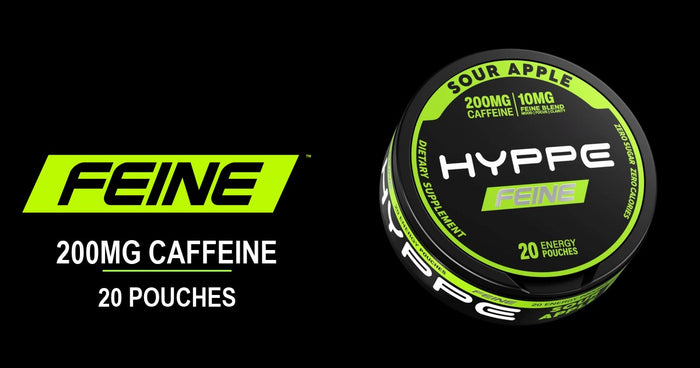
FEINE energy pouches contain 200mg of caffeine plus L-theanine. Tobacco free and nicotine free. Not intended for anyone under 18, or for people who are pregnant, nursing, or sensitive to caffeine. Research cited here was conducted on the individual ingredients at comparable doses, not on the finished FEINE product. Individual results vary. These statements have not been evaluated by the Food and Drug Administration. This product is not intended to diagnose, treat, cure or prevent any disease.
TRY IT FOR YOURSELF.
200mg caffeine and L-theanine. 20 pouches per can. Zero sugar, zero nicotine.
SHOP FEINE