Caffeine is one of the most studied compounds in sports science. That is good news, because it means we do not have to speculate. It also means the honest numbers are more modest than most marketing suggests.
Reaction time
Doses around 3mg per kg of bodyweight, roughly 200mg for many adults, have been associated with reaction time improvements in the range of 5 to 12 percent depending on the task and population.
One frequently cited example in taekwondo athletes reported reaction time dropping from about 420ms to 370ms, an improvement close to 12 percent. Work in esports players has reported smaller absolute gains, on the order of 10ms on simple reaction tasks, which matters enormously in that context and not at all in most others.
Translate that honestly: we are talking about tens of milliseconds. In a sport or a hazard, that gap decides outcomes. Doing paperwork, you will not perceive it.
Endurance
This is caffeine's strongest and most replicated effect. Meta-analyses of caffeine at 3 to 6mg/kg consistently report endurance improvements in the range of 2 to 7 percent, with time-to-exhaustion protocols often landing around 2 to 4 percent and time-trial completion times improving by roughly 2 percent.
Two percent sounds trivial until you apply it to something long. On a four hour effort, two percent is roughly five minutes.
Strength and power
The strength literature is real but more variable than the endurance literature. Meta-analyses generally find small but statistically significant improvements in maximal strength and muscular endurance, typically larger for lower body than upper body movements. Effects tend to be more consistent for total reps performed than for one-rep maximum.
Expect a rep you would not otherwise have had, not a new personal record.
The mechanism
Caffeine is an adenosine receptor antagonist. Adenosine accumulates in your brain across the day and binding to its receptors is part of what produces the sensation of fatigue. Caffeine occupies those receptors without activating them, so the fatigue signal is blunted.
This is the single most important thing to understand about caffeine: it does not create energy. It suppresses the perception of fatigue. The underlying tiredness is still there, and the sleep debt behind it still has to be paid.
Who benefits least
Three groups see smaller effects, and it is worth knowing if you are one of them:
- Habitual heavy users. Tolerance is real, and regular high intake blunts the response.
- Fast metabolizers and slow metabolizers. Variation in the CYP1A2 gene meaningfully changes how people respond, and some research suggests certain genotypes see little ergogenic benefit at all.
- The severely sleep deprived. Caffeine restores some performance, but it does not return you to a rested baseline. Nothing does except sleep.
Dose, and diminishing returns
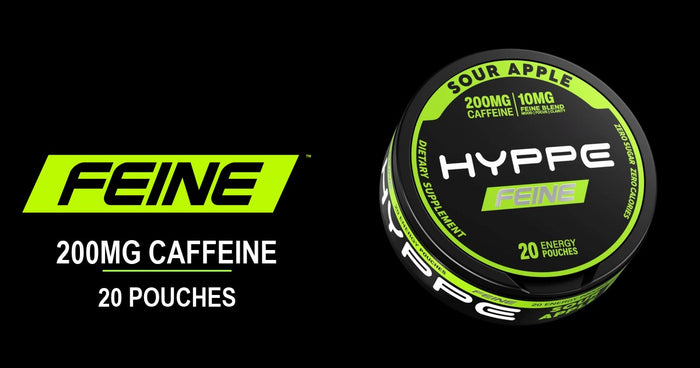
More is not linearly better. Benefits tend to plateau, while side effects, jitteriness, elevated heart rate, disrupted sleep, keep climbing. The FDA has cited 400mg per day as an amount not generally associated with negative effects in healthy adults. One FEINE pouch is 200mg, which is half that figure in a single serving, so counting the rest of your day matters.
The honest limitation
These figures come from controlled studies of caffeine at comparable doses, not from trials of FEINE. They tell you what the ingredient does. They do not tell you what this specific pouch does, and individual response varies widely.
References
Grgic J, Trexler ET, Lazinica B, Pedisic Z. Effects of caffeine intake on muscle strength and power: a systematic review and meta-analysis. Journal of the International Society of Sports Nutrition.
Southward K, Rutherfurd-Markwick KJ, Ali A. The effect of acute caffeine ingestion on endurance performance: a systematic review and meta-analysis. Sports Medicine.
Guest NS, VanDusseldorp TA, Nelson MT, et al. International Society of Sports Nutrition position stand: caffeine and exercise performance. JISSN. 2021.
Santos VG, et al. Caffeine reduces reaction time and improves performance in combat sport athletes.
U.S. Food and Drug Administration. Spilling the Beans: How Much Caffeine is Too Much.
FEINE energy pouches contain 200mg of caffeine plus L-theanine. Tobacco free and nicotine free. Not intended for anyone under 18, or for people who are pregnant, nursing, or sensitive to caffeine. Research cited here was conducted on the individual ingredients at comparable doses, not on the finished FEINE product. Individual results vary. These statements have not been evaluated by the Food and Drug Administration. This product is not intended to diagnose, treat, cure or prevent any disease.
TRY IT FOR YOURSELF.
200mg caffeine and L-theanine. 20 pouches per can. Zero sugar, zero nicotine.
SHOP FEINE